
Table of Contents
- How Far Do the Free Plans Really Go?
- Test Results: ChatGPT vs. Claude vs. Gemini Free Plan Comparison Table
- How the Test Was Conducted
- All Three Services Scored 100% on the Questions They Answered
- ChatGPT Free Plan Limit: Temporary Block After 75 Questions
- Claude Free Plan Limit: All 500 Questions Completed (5-Hour Session Reset)
- Gemini Free Plan Limit: Frequent 1095 Errors After 200 Questions
- The Answers Were Correct, but the Response Styles Were Very Different
- Gemini Often Turned Simple Answers Into Small Visual Explanations
- Sycophancy Barely Appeared in This Test
- Which Free AI Is Best?
- Final Takeaway: Accuracy Was the Same, but the Experience Was Very Different
How Far Do the Free Plans Really Go?

If you wanted to use AI for free, which one would actually be best...? ChatGPT, Claude, and Gemini all have free plans, but which one really holds up?

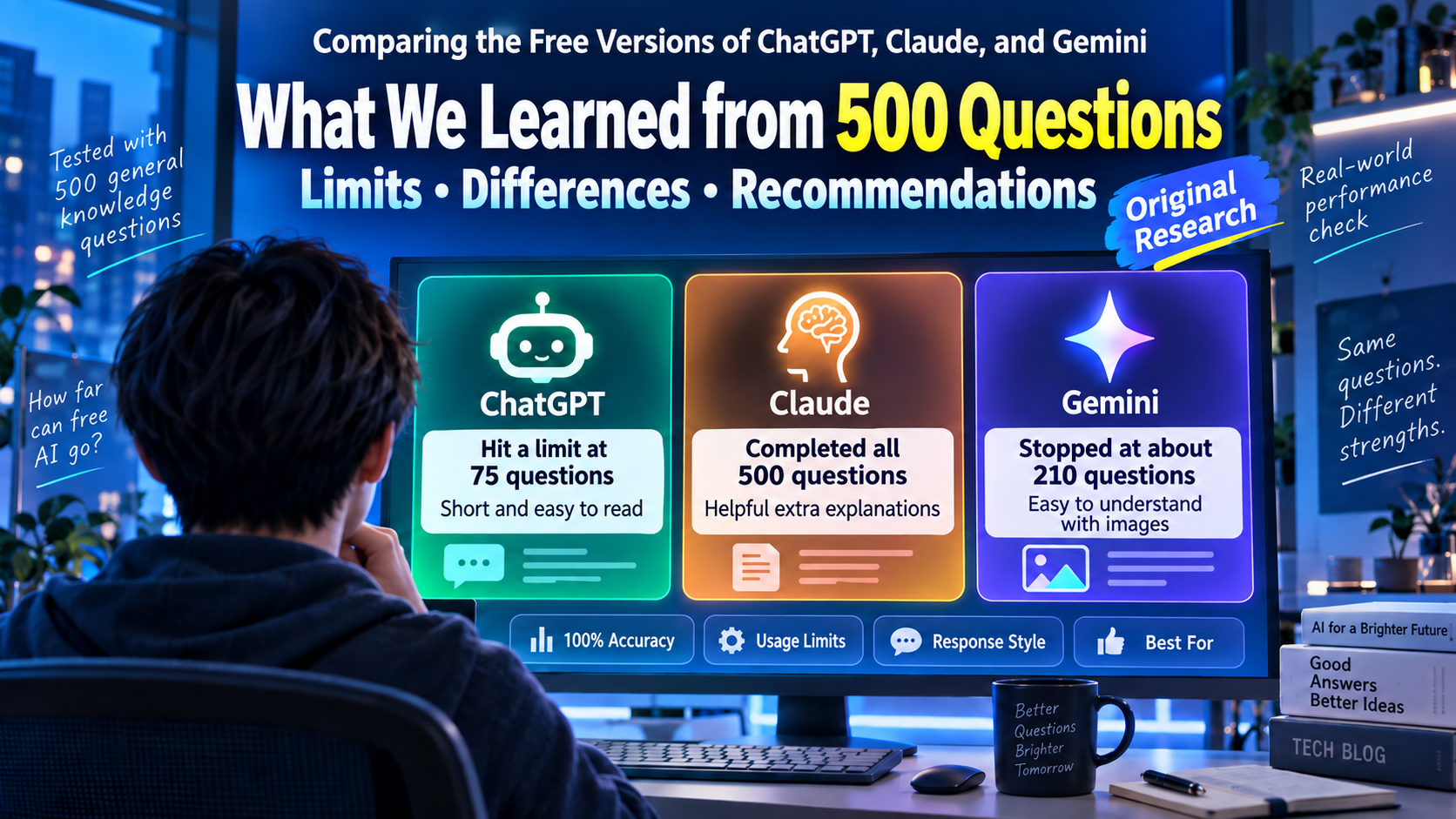
Good question. Rather than guessing, I decided to actually send the same set of up to 500 questions to each one and see how far they would really go.
ChatGPT, Claude, and Gemini can all be used for free, but it is surprisingly difficult to tell how far their free plans actually let you go.
Official sites: ChatGPT / Claude / Gemini
Each company provides some information about usage limits, but the rules are not always as simple as "X messages per day." Limits can vary depending on the type of request, conversation length, features being used, system demand, and other factors.
So I decided to run a simple experiment: ask ChatGPT, Claude, and Gemini the same set of general knowledge questions, one by one, for up to 500 questions.
I was not only interested in how many questions each service could answer before hitting a limit. I also wanted to see how their response styles differed, whether anything unusual happened during a long session, and what the free versions actually felt like when used continuously.
The results were much more distinct than I expected.
📥 Download the 500-question set (CSV)
Test Results: ChatGPT vs. Claude vs. Gemini Free Plan Comparison Table
Here is a quick summary.
| Item | ChatGPT Free | Claude Free | Gemini Free |
|---|---|---|---|
| Questions answered | 75 | 500 | 210 |
| Accuracy of main answers | 100% | 100% | 100% |
| Why the test stopped | Usage limit message | Completed all 500 | Frequent 1095 errors |
| Response style | Short, easy to read, frequent emojis | More supplementary explanation | More visual and feature-rich |
| Images shown | None, aside from UI icons | None | 35 out of 210 |
| Long-session issues | None before the limit | One unrelated answer was mixed in | Errors increased around 200 questions |
- ChatGPT Free: hit a temporary usage limit after 75 questions
- Claude Free: completed all 500 questions with no limit reached
- Gemini Free: stopped around 210 questions (frequent 1095 errors after ~200)
The questions were not designed to determine which AI was the "smartest." They were mostly straightforward general knowledge questions and simple calculations.
In that sense, this was closer to a stress test of how the free versions behave when you keep sending lightweight questions continuously.
How the Test Was Conducted
I used the browser versions of ChatGPT, Claude, and Gemini. For all three services, I used a Google account prepared specifically for this experiment, and each service was being used for the first time on that account. I did not automate the test. Every question was entered manually, one at a time.
I also left each service in its default state and did not manually change the model or other model-related settings. The models shown during the test were:
- Gemini: Flash-Lite
- Claude: Sonnet 5, Medium
- ChatGPT: Unknown
For ChatGPT, I could not clearly identify which model was being used from the interface during the test, so I have left it as unknown rather than guessing.
The question set and reference answers were prepared in English first. The 500 questions covered a mixture of topics including literature, history, geography, science, space, the human body, computers, sports, and basic math. Examples included:
- Who wrote The Great Gatsby?
- What is the capital of Peru?
- What is half of 3/5?
- Which planet is closest to the Sun?
- What does HTTPS add to HTTP?
The services were tested in basically the same question order.
All three were fast enough in practice. The recorded elapsed time also included the time I spent copying and pasting the next question, so I do not use total session time as a serious response-speed comparison.
All Three Services Scored 100% on the Questions They Answered
There was no difference in accuracy. The results were:
- ChatGPT: 75 correct out of 75
- Gemini: 210 correct out of 210
- Claude: 500 correct out of 500
So the main answer was correct in every case.
This does not mean every response matched the reference answer word for word. For example, a reference answer might say "Every four years," while a model might answer "every 4 years." Those kinds of wording differences were not counted as mistakes.
For this level of general knowledge, there was effectively no meaningful gap in accuracy between ChatGPT, Claude, and Gemini.
Important: Accuracy did not differ on these questions, so the rest of this article compares usage behavior and response style instead.
The much bigger differences appeared in free-plan limits and in how each service answered. I also compared these tools from a more practical, day-to-day angle in "Genspark vs ChatGPT vs Claude (2026): Which AI is Actually Better?", if you're curious.
ChatGPT Free Plan Limit: Temporary Block After 75 Questions
ChatGPT was the first service to stop.
After the 75th question, a message appeared saying, in effect, that the available messages had been used up and that I could try again later or start a free Plus trial.
The reset time shown was roughly 50 minutes later.
It is tempting to interpret this as something like "75 questions per hour," but that would be too strong a conclusion.
OpenAI's current official documentation states that Free users get "unlimited everyday text chats," with safeguards against abuse and separate limits for things like image generation, file uploads, voice, and data analysis (OpenAI Help Center).
The safe conclusion is simply this:
In this test, after sending 75 lightweight general knowledge questions in a short period of time from the same free account, ChatGPT temporarily stopped accepting more messages.
This does not mean that every free user will always hit a limit at 75 messages.
Still, among the three services I tested, ChatGPT was the first to display a clear usage-limit message during this continuous-question scenario.
Claude Free Plan Limit: All 500 Questions Completed (5-Hour Session Reset)
Claude produced the most surprising result.
It answered all 500 prepared questions without hitting a usage limit.
Anthropic's official help center explains that Claude Free has a session-based usage limit that resets every 5 hours, and the number of messages available can vary depending on demand and other factors (Anthropic Help Center).
That does not mean Claude Free always allows 500 questions.
What this test does show is that, under these particular conditions using short general knowledge questions, Claude handled all 500 questions continuously without reaching the limit.
Compared with ChatGPT stopping at 75 questions, that is a very noticeable difference for people who want to do a large amount of lightweight text-based work. If you want a closer look at exactly how far Claude's free tier stretches, I've also written "Is Claude's Free Plan Enough? How to Judge When It's Time to Pay".
One Strange Response Appeared During the 500-Question Run
Claude was not completely flawless during the long session.
One question asked: "What is a painting made on freshly laid wet plaster called?"
Claude correctly answered "fresco."
But after the explanation, it suddenly continued with an unrelated answer about the asthenosphere, the layer of Earth associated with tectonic plate movement. That content had nothing to do with the question being asked.
Warning: This was most likely an answer from a different question getting mixed in. Completing a long 500-question session without hitting a usage limit does not necessarily mean the session stayed perfectly stable from start to finish.
The main answer, "fresco," was still correct, so I did not count the response as a wrong answer.
Still, it was an interesting example of how a model can complete a very long session without hitting a usage limit while still showing an occasional response-mixing issue. In other words, being able to keep going for a long time does not necessarily mean the session remains perfectly clean from start to finish.
Gemini Free Plan Limit: Frequent 1095 Errors After 200 Questions
Gemini worked smoothly for most of the first 200 questions.
Then, around the 200-question mark, the following error began appearing frequently:
Something went wrong (1095)
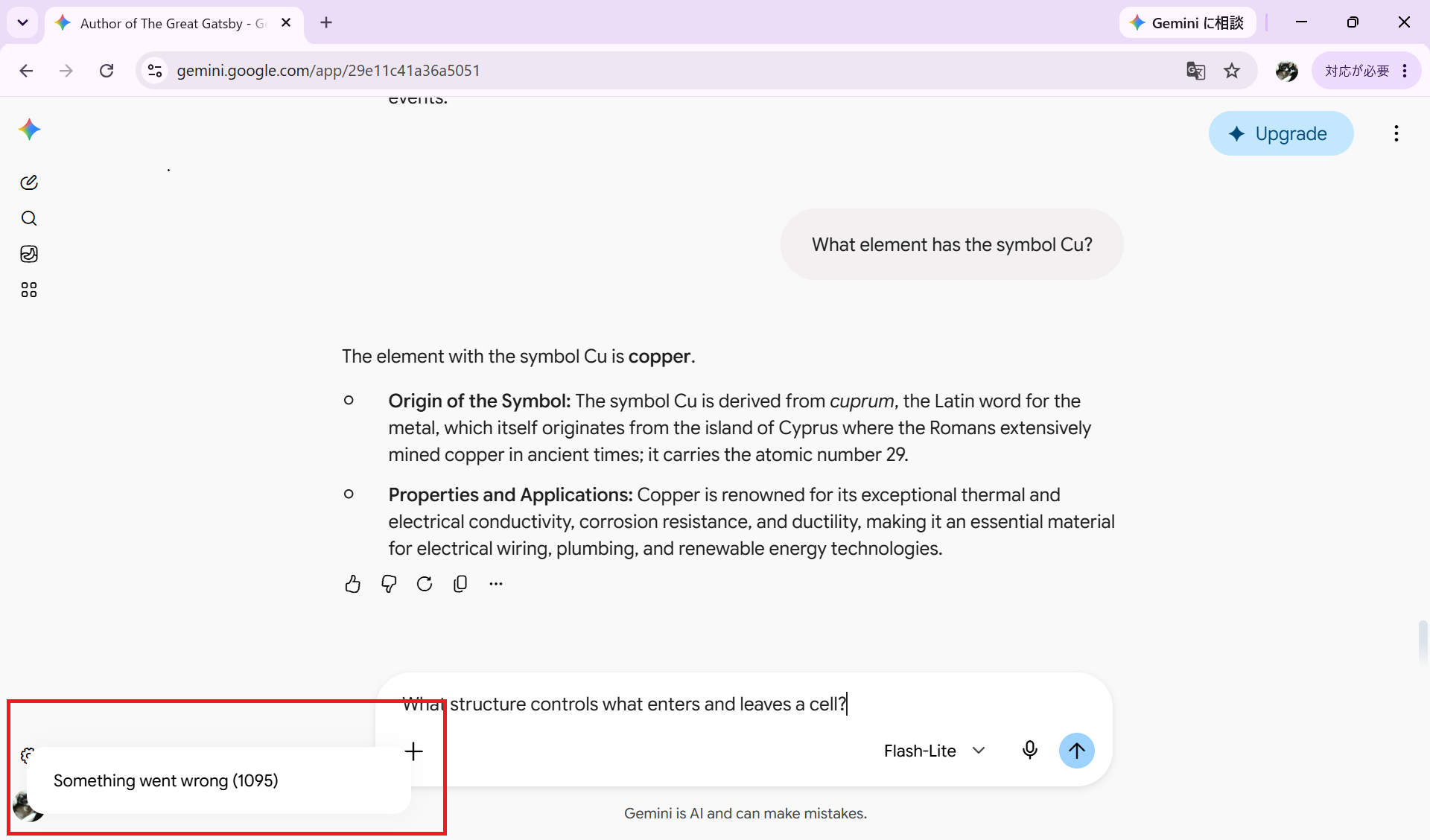
Around question 203, Gemini stopped accepting the next question and showed "Something went wrong (1095)."
At first, I thought it might simply be a temporary connection issue. However, the error continued to appear, and when I opened a brand-new chat, the same 1095 error still occurred. That suggested that the problem was not limited to one overly long conversation.
Eventually, progress slowed to the point where continuing the test became impractical, so I stopped at 210 questions.
Google explains that Gemini's usage limits are based not simply on message count but on the amount of computing resources used, factoring in prompt complexity, the model and features used, and conversation length, with a system that resets every 5 hours up to a weekly cap (Google Support).
I could not confirm an official Google explanation stating exactly what error code 1095 meant in this situation. So I do not think it would be appropriate to write "Gemini Free has a 200-question limit."
What I can say is this: in this test, frequent 1095 errors began appearing after roughly 200 questions. The same issue appeared in a new chat, and continuous use became impractical, so the test ended at 210 questions. I go into more detail on tracking Gemini's free-tier limits and reset timing in "Getting Through a Full Month on Gemini's Free Plan Alone: Knowing the Limits and Reset Timing".
The Answers Were Correct, but the Response Styles Were Very Different
Although all three services achieved 100% accuracy on the questions they answered, the way they responded felt very different.
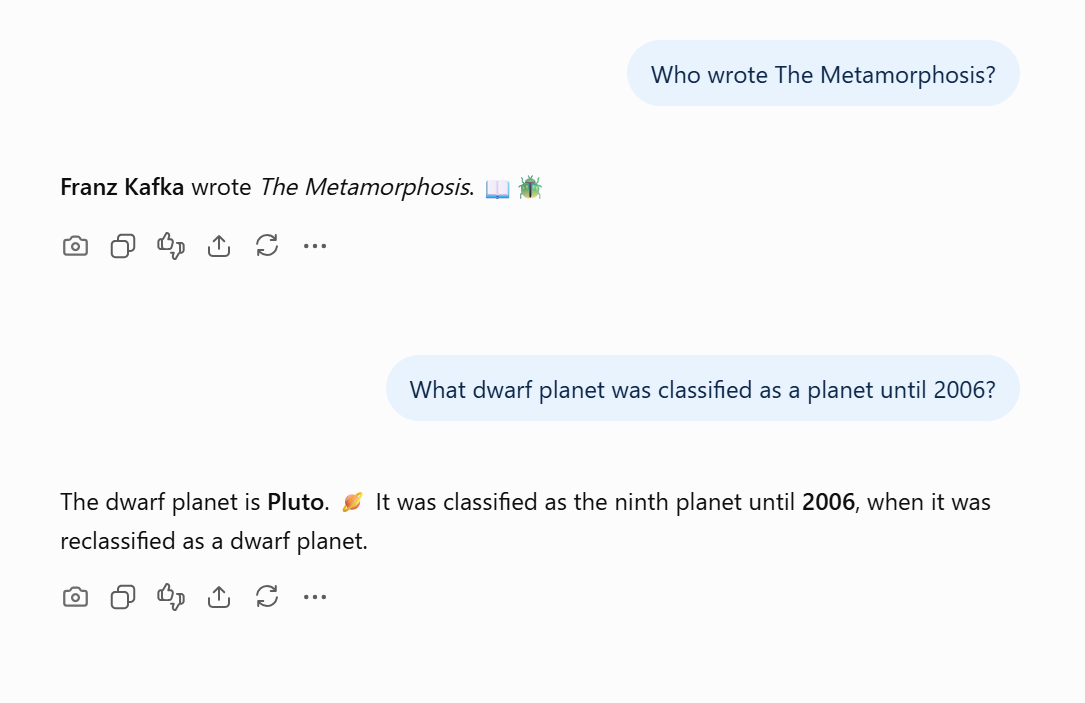
ChatGPT Was Short and Easy to Read
ChatGPT was the most direct of the three.
If I asked for the capital of Peru, the answer was basically:
The capital of Peru is Lima. 🇵🇪
For a very simple question about a zebra, the answer could be as short as:
A zebra! 🦓
One thing that stood out was the frequent use of emojis. Countries often came with flags, sports questions sometimes included sports-related emojis, and other simple facts were presented in a light, friendly style.
ChatGPT generally did not add large amounts of background information to easy questions. That made it easy to scan and comfortable for people who simply wanted the answer quickly.
When a topic benefited from a small amount of context, ChatGPT sometimes added it. For example, when explaining what a light-year is, it also mentioned the approximate distance in kilometers.
So the overall style was: short first, with a little extra detail when it seems useful. I've also written about this kind of ChatGPT-specific "tic" from a different angle in "What Is 'GPT-Style Writing'? The Telltale Patterns You Start Noticing in ChatGPT-Generated Text".
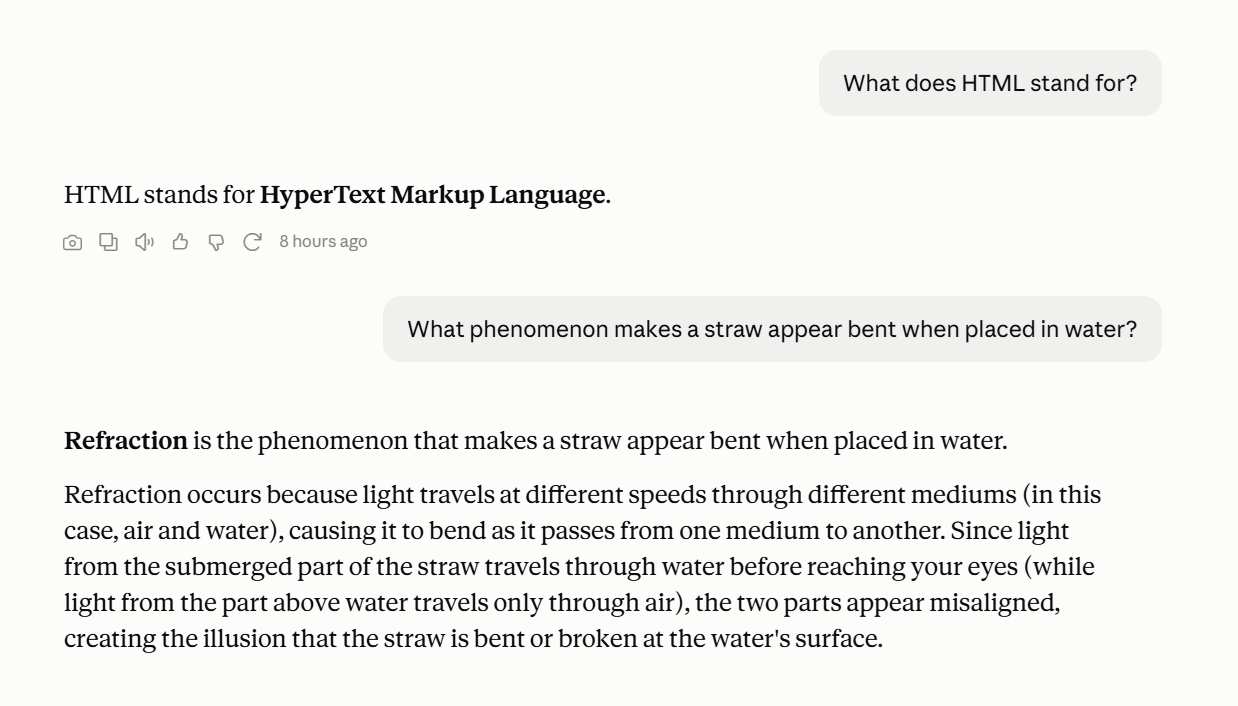
Tip: Claude tended to explain more than ChatGPT. For example, when asked "Who wrote The Great Gatsby?", Claude answered F. Scott Fitzgerald, but then also mentioned the 1925 publication date and themes such as the American Dream, wealth, and moral decay. For a tennis question asking what a score of zero is called, Claude answered "love," then added an example such as "forty-love" and briefly discussed the debated origin of the term. That does not mean every answer was long — for a very simple question, such as asking for a capital city or an easy calculation, Claude could still answer briefly. So Claude's style felt like this: simple questions stay simple, but when there is useful background to add, Claude often adds it. That makes it a good fit for people who want to learn a little more than just the answer itself.
Gemini Often Turned Simple Answers Into Small Visual Explanations
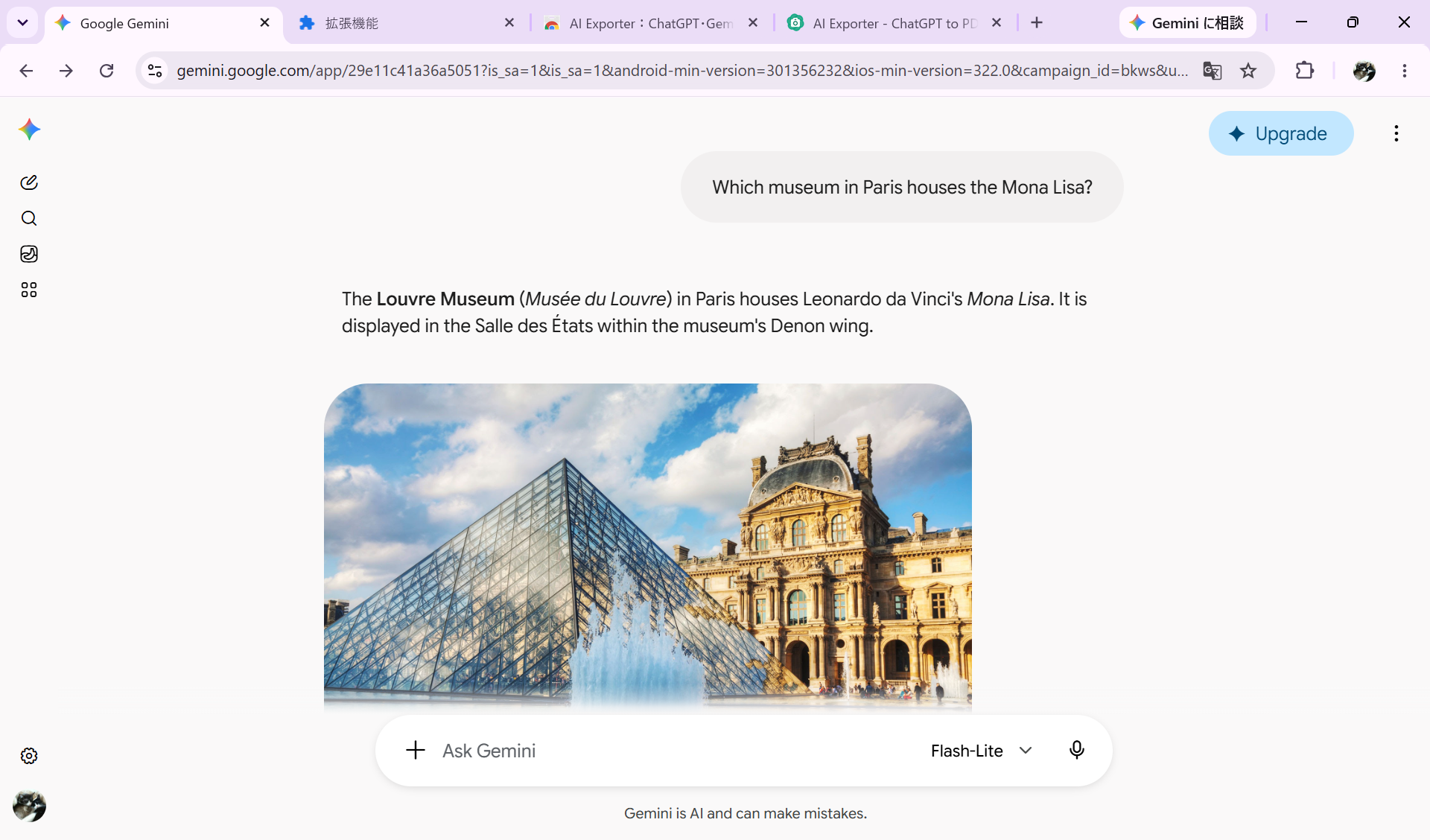
Gemini was the most distinctive of the three. Rather than only replying with text, it sometimes added images, diagrams, and other visual elements.
35 of 210 Answers Included Images
Out of the 210 answers Gemini produced, 35 were shown with images. That is about 17%.
Example: Examples included:
- Louvre Museum → an image of the Louvre
- Petra → an image of Petra
- zebra → a zebra
- Tchaikovsky → a portrait of Tchaikovsky
- Italy → a map showing the boot-shaped peninsula
- HTTPS → an SSL/TLS explanatory diagram
- methane → a molecular model
- patella → a diagram of the human knee
I checked all of the images that were actually displayed, and they matched the questions appropriately.
In some cases, especially geography, anatomy, and IT, the visual explanation made the answer easier to understand than text alone. That was one of Gemini's most noticeable strengths in this test.
Sycophancy Barely Appeared in This Test
I was also curious whether any of the services would show obvious sycophantic behavior.
By "sycophancy," I mean things such as excessive agreement, unnecessary praise, or opening simple questions with phrases like:
"Great question!" or "Absolutely!"
I had personally seen that kind of behavior from Gemini in normal use before, so I expected it might appear here.
It did not. Searching the logs for phrases such as "Great question" and "Absolutely" found essentially nothing across Gemini, Claude, or ChatGPT.
When you think about it, this makes sense. If the user asks, "What is 13 × 5?", then answering "Great question!" would be strange. So this test was probably not well suited to triggering sycophancy.
If the prompts involved personal opinions, advice, or statements the user wanted validated, the result could be very different.
For this test, the conclusion is simply: with short general knowledge questions, none of the three services showed much unnecessary praise or agreement.
I did not expect Claude to make it all the way through 500 questions on the free plan!
Same here. Do not underestimate a free plan -- it is worth actually testing the one that fits how you plan to use it.
Which Free AI Is Best?
I do not think this test supports declaring one service the absolute winner. The three free versions have noticeably different strengths.
Best for Asking Lots of Questions: Claude
The biggest result from this test was Claude finishing all 500 questions. ChatGPT stopped at 75, and Gemini became difficult to use around 200. So for large volumes of short text-based questions, Claude was the easiest to keep using under these test conditions.
Its tendency to add useful background information also makes it a good option for study and learning. The one unrelated answer that appeared during the 500-question session is worth noting, but overall Claude remained surprisingly stable.
Best for Learning With Images and Visuals: Gemini
Gemini gave the most visually rich answers. It regularly added maps, portraits, animals, diagrams, and technical illustrations.
If you only want a short answer, that can sometimes feel like more information than necessary. But if you like learning visually, Gemini was easily the most interesting of the three in this test.
Best for Short, Easy-to-Read Answers: ChatGPT
ChatGPT hit a temporary limit after 75 questions, so it did not perform best in this particular continuous-use stress test. However, the answers themselves were very easy to read.
ChatGPT usually gave the answer first, added only a small amount of explanation when needed, and often used emojis to keep the tone light. For normal day-to-day use, that makes it very comfortable.
It is also worth remembering that continuously asking dozens or hundreds of questions with almost no break is an unusual usage pattern. Most free users are unlikely to send 75 questions in such a short period of time. For a more practical, case-based comparison of which tool actually fits personal development work, see "Genspark, Claude, or Gemini — Which One Actually Works for Personal Development? Comparing Real Cases".
Final Takeaway: Accuracy Was the Same, but the Experience Was Very Different
In this test, I asked ChatGPT, Claude, and Gemini up to 500 general knowledge questions.
What impressed me most was that all three services achieved 100% accuracy on the main answers they actually provided.
The difference was not in basic knowledge accuracy. The difference was in how long the free versions kept going and how they presented their answers.
If I had to summarize the results very simply:
Claude lasted the longest.
Gemini gave the richest visual responses.
ChatGPT was the shortest and easiest to read.
Free-plan limits are not fixed forever. They may change depending on the date, account, system demand, selected model, feature usage, and conversation length.
So if the same experiment were repeated later, the numbers could be different.
Still, asking the same set of questions repeatedly revealed differences that are difficult to see from pricing tables or official feature lists alone.
If you are deciding which free AI to use, this test suggests the following: Claude for large volumes of short, English knowledge-style questions like these, Gemini for visual explanations, and ChatGPT for short, straightforward everyday answers.
This test was conducted on September 5, 2026, using individual free accounts. All three services were tested in their browser versions with their default settings, and I did not manually switch models. Gemini displayed Flash-Lite, Claude displayed Sonnet 5 with Medium settings, while the specific ChatGPT model could not be clearly identified from the interface. Usage limits and behavior may vary depending on time, account conditions, system demand, selected features, models, and conversation content. I also could not confirm any official Google documentation stating that Gemini error code "1095" specifically means a usage-limit error, so this article only describes what was actually observed during the test.