Table of Contents
- Overview
- Success story 1: shipped to the App Store in a day
- Success story 2: a personal workout-log app
- The shared success pattern: spend time up front on preparation
- What to include in a spec document
- The review period behind "shipped in a day"
- A 3-stage structure that keeps deployment in view
- Summary
Overview
Reports like "I built an app with Claude Code and shipped it to the App Store in a single day," or "I built a personal workout-log app over Golden Week," come across as remarkably fast. But unpack the secret behind that speed, and a somewhat paradoxical fact shows up again and again: the real time investment went into preparation.
Success story 1: shipped to the App Store in a day
In one case, handing over a spec document produced results close to a one-shot implementation, the AI even auto-generated the privacy policy document, and whenever an error came up, simply pasting it in got an immediate fix. The end result, reportedly, was shipping to the App Store in just a single day. With nearly the entire workload handed off to the AI, this case seems to symbolize just how capable Claude Code can be.
Success story 2: a personal workout-log app
In another case, someone used their Golden Week holiday to build a workout-log app for the gym. They chose Expo (React Native) and Supabase as the tech stack, used Claude Code for implementation and Claude Design for the visual side, and completed planning, design, implementation, design, and distribution entirely solo. Combining multiple tools, each suited to the right job, clearly contributed to the polish of the finished product.
The shared success pattern: spend time up front on preparation
What both of these cases have in common is that the more time spent on preparation — writing the spec — the faster the later stages go. Rather than giving the AI instructions on the fly, preparing a solid spec document ahead of time lets the AI produce something close to correct in one shot without hesitating — a takeaway shared by many practitioners.
What to include in a spec document
Concretely, a spec document is best built around these elements:
- Feature list (what the app can do)
- Screen flow (which screen leads to which)
- Data structure (what information is stored and managed)
- Tech stack used (framework, database, etc.)
Putting these together ahead of time makes your instructions to the AI concrete, and tends to lead to development with far less rework.
The review period behind "shipped in a day"
Seeing a report that says "shipped in a day," you might wonder whether that really includes the app-store review process. In fact, according to Apple's own figures, 50% of submitted apps are reviewed within 24 hours, and over 90% within 48 hours. In other words, if you can get from implementation to store submission within a day, the review itself is often done within another day or two — that is the reality behind these stories.
If you want to test things before an official release, there's also TestFlight. It offers "internal testing," which lets developers distribute to each other without review, and "external testing," which goes through review before distributing to outside testers — and the first review for external testing reportedly takes around a day. After that first review, though, subsequent updates tend to clear review quickly. Submitting on a Friday night can end up taking until Monday because of the weekend in between, so it's worth being mindful of the day of the week if you're in a hurry to ship.
A 3-stage structure that keeps deployment in view
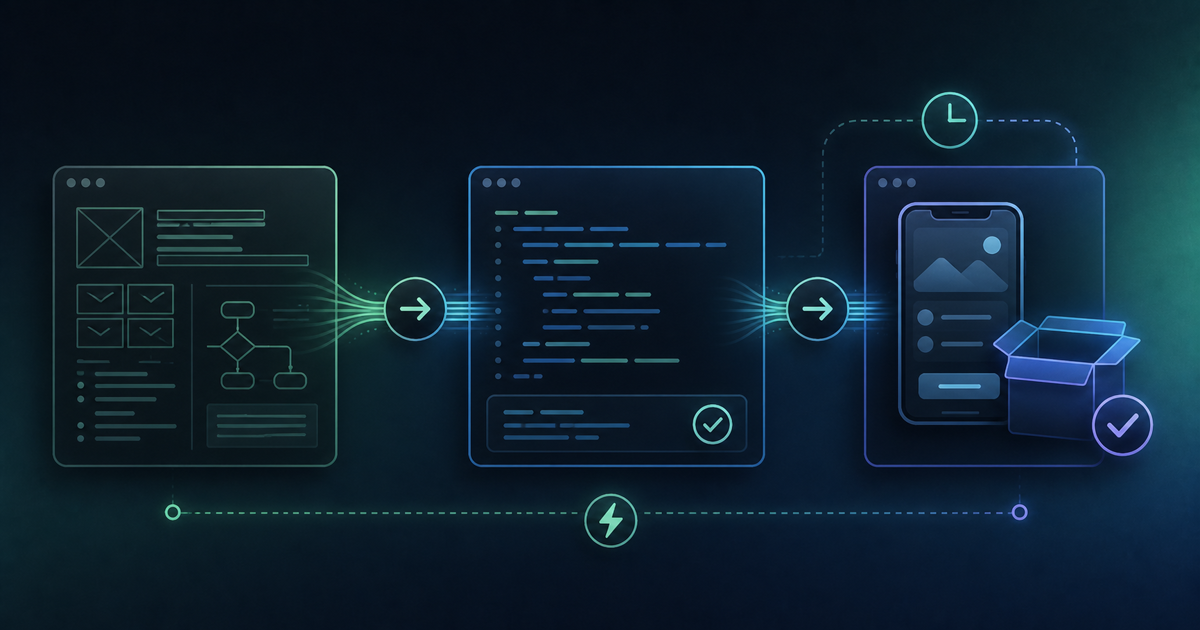
Zooming out, app development breaks down roughly into three stages: "prep," "build," and "deploy." Many explanations focus heavily on the build stage, but actually getting an app out into the world requires keeping the release procedures in view as well. Deciding, even at the spec stage, how far you intend to release it (internal-only vs. public) tends to make the later stages go more smoothly.
Summary
The points for finishing an app quickly with Claude Code can be organized as follows:
- Before diving into implementation, prepare a spec document covering the feature list, screen flow, data structure, and tech stack
- When an error appears, paste it exactly as-is and fix it immediately
- Keep design and release procedures in view too, not just implementation — combine multiple tools where each fits best
Behind the flashy result of "the app was done in a day" lies a steady accumulation of preparation. Rather than rushing into implementation, spending time up front on the spec document ends up being the fastest path in the end.